

How Layered Nano Flame Retardants Address High Filler Loading in Low-Smoke EVA Cable Compounds
How Layered Nano Flame Retardants Address High Filler Loading in Low-Smoke EVA Cable Compounds
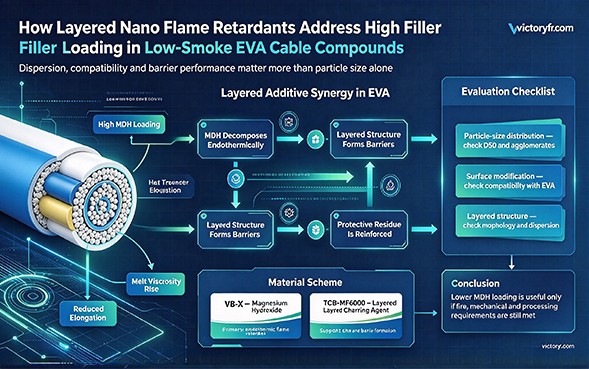
High MDH loading can help EVA cable compounds meet flame-retardant requirements, but it also makes them harder to process. Melt viscosity may rise, elongation can fall, and extrusion becomes more difficult to control.
Layered additives may help address this trade-off by reinforcing the protective residue formed during burning. How well they work depends largely on their dispersion and compatibility with EVA.
Victoryfr supplies natural brucite-based MDH and layered charring agents for halogen-free formulations. In EVA cable compounds, their suitability needs to be checked against flame performance, extrusion behavior, and mechanical requirements.
Why High MDH Loading Causes Processing Problems
MDH absorbs heat and releases water during decomposition. The remaining magnesium oxide contributes to the protective mineral residue.
However, high mineral loading may cause:
- Particle agglomeration and uneven dispersion.
- Increased extrusion pressure and melt viscosity.
- Lower flexibility and elongation at break.
- Rough cable surfaces caused by poorly dispersed fillers.
This makes dispersion control just as important as the amount of MDH added.
How Layered Nano Flame Retardants Support MDH Synergy
Layered nano materials can form barriers that slow heat transfer and the movement of combustible decomposition products. This complements MDH's endothermic decomposition mechanism.
Yen, Wang, and Guo examined EVA composites containing metal hydroxides and nanoclay.¹ In the formulations they tested, replacing 1–2 wt% of the metal hydroxide with nanoclay improved limiting oxygen index (LOI) while maintaining a UL-94 V-0 rating. Peak heat release rate also fell by approximately 28%–47% in cone calorimeter testing.
The researchers attributed the improved flame resistance and smoke suppression to a compact silicate-reinforced metal oxide layer that limits heat transfer and the release of combustible gases.¹
Victoryfr's VB-X magnesium hydroxide and montmorillonite-based TCB-MF6000 charring agent address two different parts of a flame-retardant system. VB-X acts as the main endothermic flame retardant, while TCB-MF6000 is designed to support char and barrier formation. The next step is to test whether this combination produces similar benefits in an actual EVA cable formulation.
Why Dispersion Matters More Than Particle Size Alone
A smaller particle size does not always mean better dispersion. Fine particles can still cluster inside EVA, creating weak spots and limiting the barrier effect they are meant to provide.
When comparing grades, check particle-size distribution, surface treatment, and how the layered structure behaves in the finished compound.
- Particle-size distribution: A low D50 is useful, but it will not reveal every large agglomerate that could affect cable quality.
- Surface modification: Appropriate treatment can improve compatibility with EVA and reduce particle clustering.
- Layered structure: Microscopy and X-ray diffraction can help examine particle morphology and layer spacing. These results should be considered alongside actual dispersion in the polymer.
Can Layered Additives Reduce Total Filler Loading?
Reducing the amount of a primary flame retardant is not necessarily the same as reducing total mineral filler content.
A study by Fu and Qu, published in Polymer Degradation and Stability, investigated the synergistic effects of fumed silica in EVA/magnesium hydroxide blends.² The researchers reported that MDH content could be reduced from 60 wt% to 55 wt%, with an 8 wt% fumed silica addition identified in the study as an effective level, while maintaining a UL-94 V-0 rating.
This example shows how a secondary additive can help maintain flame performance with less MDH, although the combined mineral content may increase.
Yen et al. also observed improved flame performance when small amounts of nanoclay replaced part of the metal hydroxide in EVA composites.¹ Unlike fumed silica, nanoclay provides a layered structure that can contribute to protective barrier formation. The results suggest that partial substitution is worth investigating, but they do not establish a universal reduction in filler requirements.
For cable compound manufacturers, three outcomes should be evaluated separately:
- Reduced primary flame-retardant loading: Less MDH or ATH is required.
- Reduced total mineral loading: The combined amount of mineral additives decreases.
- Improved overall formulation performance: Fire, smoke, mechanical, and processing requirements are maintained or improved.
Lower MDH content is useful only if the finished compound still meets its fire, mechanical, and processing requirements. Total mineral content should therefore be checked separately.
Evaluating Layered Flame Retardants for EVA Cable Compounds
An MDH replacement and a barrier-forming additive are not evaluated in the same way. The main differences are outlined below.
| Material | Primary function | Main evaluation concern |
|---|---|---|
| Magnesium hydroxide | Heat absorption and smoke suppression | Loading, dispersion, and mechanical properties |
| Nanoclay | Layered barrier formation | Nanoscale structure and polymer dispersion |
| Conventional layered silicates | Protective residue and possible charring synergy | Surface compatibility and structural evidence |
| Fumed silica | Secondary mineral reinforcement and fire-performance synergy | Rheology and formulation-specific performance |
For example, a conventional layered silicate may contribute to barrier formation without meeting the structural criteria for a verified nano-grade additive.
Victoryfr's Mineral Flame-Retardant Materials
Victoryfr supplies mineral-based materials for halogen-free flame-retardant applications, including Magnesium Hydroxide VB-X. Produced through the deep processing of natural brucite, this ultrafine MDH grade features a uniform particle-size distribution and good powder flowability, making it a relevant option for mineral-filled polymer formulations.
Victoryfr also offers TCB-MF6000, a charring agent based on a layered montmorillonite structure, with charring and barrier formation among its intended functions.
These products represent two different material approaches:
- VB-X: A primary mineral flame retardant.
- TCB-MF6000: A layered charring agent for potential synergistic formulation development.
Conclusion
Layered additives can strengthen the protective residue in MDH-filled EVA compounds, but their value depends on more than flame-test results. Cable manufacturers also need to check whether the formulation remains workable during extrusion and meets mechanical requirements.
Victoryfr's VB-X and TCB-MF6000 offer two material routes worth examining together when developing these systems.
References
1.Yen, Y.-Y., Wang, H.-T., & Guo, W.-J. (2012). Synergistic flame retardant effect of metal hydroxide and nanoclay in EVA composites. Polymer Degradation and Stability, 97(6), 863–869.
2.Fu, M., & Qu, B. (2004). Synergistic flame retardant mechanism of fumed silica in ethylene-vinyl acetate/magnesium hydroxide blends. Polymer Degradation and Stability, 85(1), 633–639.
