

How Victoryfr's VC Series Supports Char Formation in MDH-Based LSZH Cable Compounds
How Victoryfr's VC Series Supports Char Formation in MDH-Based LSZH Cable Compounds
High magnesium hydroxide (MDH) loading provides essential flame retardancy and smoke suppression in low-smoke zero-halogen (LSZH) cable compounds. However, increasing MDH content does not automatically produce a stable protective char layer or eliminate dripping during combustion. Excessive mineral loading can also create challenges for extrusion and mechanical performance.
Victoryfr's VC Series is an organically modified layered-silicate additive designed for MDH-based LSZH formulations. The series includes VC-M6004 and VC-M6003, two primary charring-agent grades. The series includes VC-M6004 and VC-M6003, two primary charring-agent grades. The technology targets char formation and barrier reinforcement, while its effects on residue integrity and dripping are assessed within the selected polymer–MDH system.
Why MDH-Based LSZH Compounds Need Layered-Silicate Char Protection
MDH absorbs heat and releases water during thermal decomposition, helping control combustion and smoke. However, highly filled EVA and PE compounds can still face weak char integrity, molten dripping and processing instability.
Layered silicates contribute a physical barrier within the combustion residue, helping restrict heat and gas transfer. Their effectiveness in improving residue integrity or reducing dripping depends on dispersion, additive loading and polymer compatibility. These effects are verified within the complete LSZH formulation rather than inferred from the mineral structure alone.
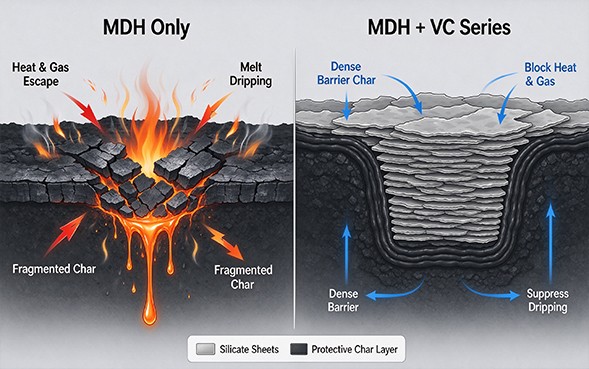
How to Improve Char Formation in MDH-Based LSZH Cable Compounds
Improving char formation begins with identifying the specific performance limitation in an existing formulation.
Consider a highly filled EVA or PE cable sheath that already meets its basic flame-retardancy requirement but produces fragmented residue or unwanted dripping during testing.
A layered-silicate synergist can be evaluated through the following three-step process.
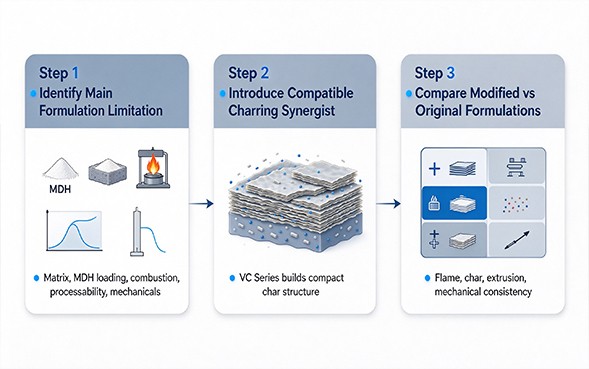
Step 1: Identify the Main Formulation Limitation
Before modifying the flame-retardant system, establish the compound's existing performance.
The initial assessment should cover:
● Polymer matrix: EVA, PE or another thermoplastic resin.
● MDH characteristics:Particle size, surface treatment and mineral loading.
● Flame behavior: Required flame-test results, char integrity and dripping.
● Extrusion conditions: Processing temperature, melt behavior and production stability.
● Mechanical properties: Tensile strength and elongation requirements.
These factors help distinguish a char-formation problem from poor dispersion or unstable extrusion.
For example, a compound showing weak residue integrity may require additional barrier reinforcement. A formulation with severe particle agglomeration must first address mineral distribution.
Step 2: Introduce a Compatible Charring Synergist
Once the limitation is identified, evaluate a layered-silicate synergist within the existing polymer–MDH system.
Start by defining how the synergist enters the formulation:
● Addition method:Record whether the synergist is added to the existing formulation or replaces part of the mineral filler.
● Filler composition:Record the resulting MDH content, synergist dosage and total filler loading.
● Processing response: Compare particle dispersion, mixing torque, melt flow and extrusion behavior with the original compound.
Keep the main processing and testing conditions consistent between the baseline and modified formulations. This makes changes in fire performance, residue integrity and processability easier to identify.
Victoryfr's VC Series provides one layered-silicate route for evaluating char reinforcement and anti-dripping behavior alongside MDH.
The synergist should be tested within the complete compound rather than evaluated as an isolated flame-retardant additive.
Step 3: Compare the Modified and Original Formulations
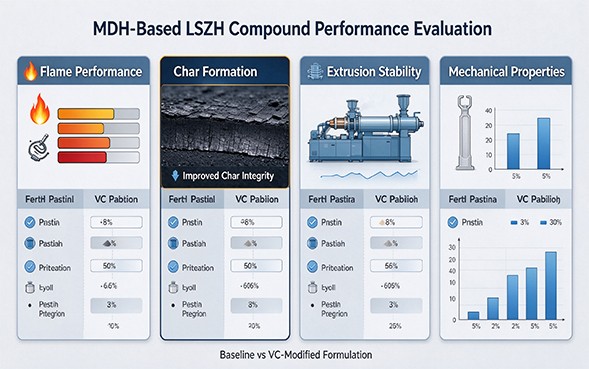
The final assessment should compare the original MDH compound with the modified formulation under equivalent testing conditions.
Evaluation area | Key parameters | Qualification objective |
Flame performance | Flame-test results, dripping behavior | Meet the required cable fire-performance specification |
Char formation | Residue continuity, density and integrity | Improve protective barrier consistency |
Extrusion stability | Melt pressure, flow behavior, surface quality | Maintain stable processing conditions |
Mechanical properties | Tensile strength, elongation | Retain the required cable properties |
Visual examination identifies changes in residue continuity and structural integrity. However, the remaining layer may contain both carbonaceous char and inorganic mineral residue. For a more reliable assessment, TGA can measure residual mass, while SEM-EDS or FTIR can provide further information on residue characteristics when needed.
How to Verify Charring-Agent Stability During High-Temperature Extrusion
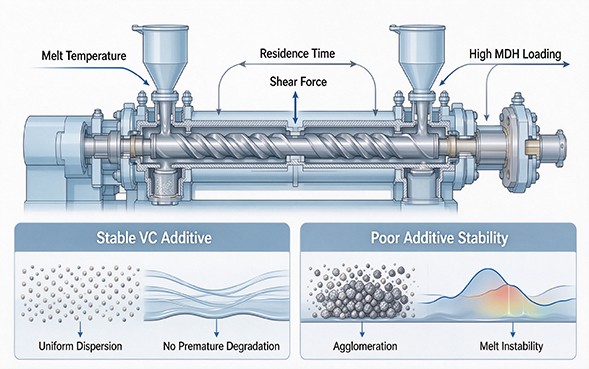
Evaluate the selected charring-agent grade under the intended compounding and extrusion conditions, including melt temperature, residence time and shear exposure.
Check the Actual Extrusion Conditions
Establish the processing window of the complete formulation using the following parameters:
● Melt and extrusion temperature: Verify material behavior at the actual operating temperature.
● Residence time:Examine the effect of extended thermal exposure during continuous production.
● Mixing and shear:Evaluate additive distribution and compound-flow stability.
● MDH loading: Confirm how high mineral content affects the modified formulation.
● Polymer compatibility: Check whether the synergist changes processing behavior in EVA or PE.
These parameters help assess whether the selected charring agent remains suitable under the proposed manufacturing conditions.
Monitor Processing and Mechanical Changes
During extrusion trials, several observations provide useful evidence of material compatibility:
● Unexpected melt-pressure or torque fluctuations.
● Changes in melt flow or compound viscosity.
● Surface defects and particle agglomeration.
● Signs of premature thermal degradation.
● Reduced tensile strength or elongation after processing.
For high-temperature LSZH applications, a charring agent should only be qualified after the selected grade has been tested under the intended extrusion conditions.
From Laboratory Formulation to Industrial LSZH Production
During longer production trials, record melt pressure, torque and cable surface quality throughout the extrusion run. Collect samples at different production stages to check whether the results remain consistent as processing continues.
Compare these samples with the laboratory formulation, focusing on:
● Extrusion consistency: Changes in melt pressure, torque and surface appearance during continuous operation.
● Fire performance:Differences in flame-test results, dripping and combustion residue between laboratory and production samples.
● Mechanical properties: Changes in tensile strength and elongation after extended processing.
These comparisons reveal whether the formulation maintains its required performance beyond short laboratory trials. Significant differences indicate where processing conditions or additive dispersion need further adjustment.
Victoryfr supplies magnesium hydroxide and mineral-based charring-agent technologies for flame-retardant formulation development.
FAQ
Why Add a Charring Agent to an MDH-Based LSZH Cable Compound?
MDH provides the primary flame-retardant function, while a charring agent adds a barrier-forming mechanism during combustion. Victoryfr's VC Series is designed for this purpose, with its effects on residue integrity and dripping verified in the selected polymer–MDH formulation.
How Can Char Formation Be Improved Without Increasing MDH Loading?
A compatible layered-silicate synergist introduces an additional barrier-forming function without increasing MDH content. Optimizing its dosage and dispersion helps improve the formulation, while comparative fire testing confirms the actual effect on residue integrity.
How Is a Charring Agent Tested for High-Temperature Cable Extrusion?
Test the selected grade at the actual extrusion temperature and residence time. Monitor melt stability, surface quality and signs of thermal degradation, then confirm flame and mechanical performance.
Conclusion
MDH-based LSZH cable compounds benefit from targeted charring-agent modification when residue integrity or dripping behavior remains a limitation. Victoryfr's VC Series provides an organically modified layered-silicate approach for this application, adding a barrier-forming function to the existing mineral flame-retardant system.
The selected VC grade should be evaluated against the original MDH formulation under comparable processing and fire-test conditions. The decision to adopt the modified formulation depends on measurable changes in residue integrity and dripping behavior, together with stable extrusion and the required mechanical properties.
