

Impact Retention in Modified Polymer Blends: Dispersion Checks for Nano Flame Retardants
Impact Retention in Modified Polymer Blends: Dispersion Checks for Nano Flame Retardants
A polypropylene (PP) electrical housing may pass a flame-resistance test but still become brittle during assembly. Filler clusters, poor adhesion between mineral particles and PP, or excessive mineral loading may contribute to the problem. Switching to a finer flame retardant alone will not necessarily restore impact strength.
In impact-sensitive PP blends, the first step is to find out where the toughness is being lost. / supplies mineral flame retardants, layered charring agents, and modified fillers for polymer formulations. These materials need to be assessed for dispersion, surface compatibility, and flame performance rather than judged by particle size alone.
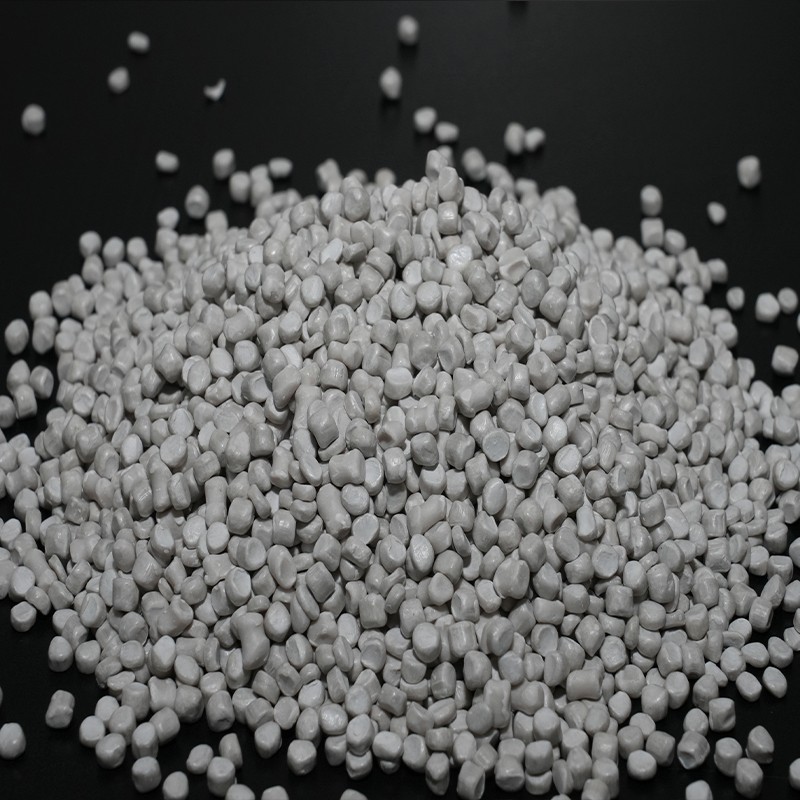
Impact Loss in a Flame-Retardant PP Housing
Consider a hypothetical PP electrical enclosure formulation that meets its flame-resistance target but shows reduced notched impact strength.
Several possible causes deserve investigation:
- Particle aggregation: Large filler clusters may become points where cracks begin under impact.
- Poor interfacial adhesion: Weak bonding between mineral particles and PP can allow cracks to spread more easily.
- Excessive filler loading: High mineral content may limit the compound's ability to deform under impact.
Start by comparing the modified compound with its original reference formulation under similar molding and test conditions. Check filler distribution, loading, and processing conditions before deciding whether a different additive is needed.
How Different Mineral Additives Affect the Formulation
The relevant checks depend on the type of filler or flame retardant being used.
| Material | Main function | What to check |
|---|---|---|
| Layered nano flame retardants | May support protective barrier formation | Layer structure and dispersion |
| Surface-modified mineral additives | Improve compatibility with the polymer matrix | Surface treatment and interfacial adhesion |
| Magnesium hydroxide (MDH) | Provides endothermic flame-retardant action | Loading, dispersion, and mechanical performance |
| Modified talc | Functional filling and reinforcement | Impact properties and polymer compatibility |
Layered nanoscale additives may help slow heat and gas transfer during combustion, but clusters of those same particles can create weak points in a molded part.
Surface treatment can improve polymer compatibility. It does not, however, turn a conventional mineral filler into a nano-grade flame retardant.
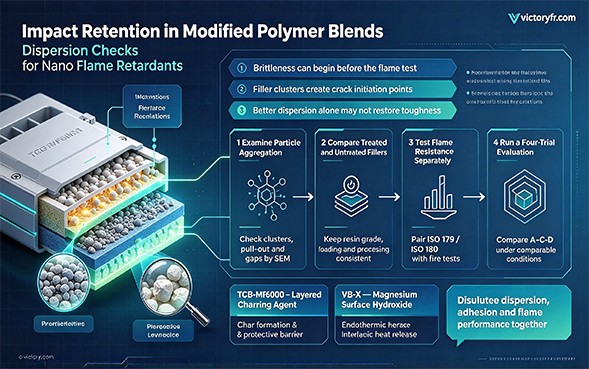
Three Dispersion Checks Before Changing Materials
1. Examine Particle Aggregation
Use scanning electron microscopy (SEM) to compare fractured surfaces or prepared sections of the reference and modified compounds.
Look for large particle clusters, uneven filler distribution, and signs of particle pull-out or gaps around filler particles.
If impact strength drops alongside more pronounced aggregation, review the mixing conditions and filler compatibility before increasing flame-retardant loading. A different mixing process may be worth testing before replacing the material.
2. Compare Surface-Treated and Untreated Fillers
PP is nonpolar, so untreated mineral surfaces may have limited compatibility with the polymer.
Compare treated and untreated fillers under the same conditions. Keep the polymer grade, filler loading, and processing parameters consistent so that differences in performance can be assessed more reliably.
Record the following:
- Notched impact strength.
- Tensile strength and elongation.
- Particle dispersion.
- Melt behavior.
Better dispersion does not necessarily restore impact strength. If the treated filler disperses more evenly but the compound remains brittle, examine total mineral loading, interfacial adhesion, and the toughness of the PP matrix itself.
3. Test Flame Resistance Separately
A blend that retains more impact strength may still fail its fire requirement if the primary flame retardant is reduced.
Use an appropriate impact test, such as ISO 179 or ISO 180, alongside the fire tests specified for the finished component.
Both results matter. A formulation that performs well mechanically but fails its flame-resistance target is not ready for further development.
A Practical Four-Trial Evaluation
A four-trial comparison can help narrow down the cause of impact loss before making larger formulation changes.
| Trial | Formulation change | Evaluation objective |
|---|---|---|
| A | Original flame-retardant PP compound | Establish reference performance |
| B | Adjust mixing while keeping the formulation unchanged | Check whether processing improves dispersion |
| C | Evaluate a surface-modified filler alternative | Examine compatibility and impact retention |
| D | Evaluate a layered synergist with adjusted mineral loading | Assess the balance between flame resistance and impact strength |
For each trial, record impact strength, dispersion observations, fire-test results, and processing behavior. Keep molding and testing conditions comparable so that changes in material performance can be interpreted more clearly.
Victoryfr Materials for Modified Polymer Formulations
Victoryfr supplies mineral flame retardants, layered charring agents, and surface-modified fillers for polymer formulation development. These materials serve different roles in flame-retardant plastics, from heat absorption and protective barrier formation to filler–polymer compatibility.
TCB-MF6000 Layered Charring Agent
TCB-MF6000 is a mineral-based charring agent featuring a layered montmorillonite structure. During combustion, its intended role is to support char formation and the development of a protective barrier that limits heat transfer and the movement of combustible gases.
In mineral-filled polymer systems, this provides a different flame-retardant mechanism from that of conventional metal hydroxides. When evaluating TCB-MF6000 in an impact-sensitive PP blend, dispersion and mechanical performance should be checked alongside any improvement in flame resistance.
Magnesium Hydroxide VB-X
VB-X is an ultrafine magnesium hydroxide powder produced through the deep processing of natural brucite. It features high purity, uniform particle-size distribution, and good powder flowability.
As a halogen-free mineral flame retardant, VB-X absorbs heat and releases water during thermal decomposition. This contributes to flame retardancy and smoke suppression without relying on a layered barrier mechanism.
For modified PP formulations, its loading level and distribution within the polymer remain important factors to examine during impact testing.
Modified Talc Powder VT-X-AS
VT-X-AS is a surface-modified talc powder processed with surface-active agents and specialized processing additives.
The surface treatment is designed to improve dispersion and interfacial compatibility in polymer matrices, including polyolefins such as PP and PE. This makes VT-X-AS a relevant functional filler when filler distribution and polymer compatibility are concerns.
As a reinforcing mineral filler, its contribution to mechanical performance depends on the final formulation. Comparing impact strength and dispersion against an untreated filler can help determine whether the modified grade offers an advantage.
Conclusion
Loss of impact strength in flame-retardant PP is not always a particle-size problem. SEM observations, controlled filler comparisons, and paired fire and impact tests can help distinguish poor dispersion from interfacial problems or excessive loading.
Victoryfr's TCB-MF6000 charring agent, VB-X magnesium hydroxide, and VT-X-AS modified talc provide different material approaches for investigating these issues. Their suitability depends on how the finished PP compound performs under the required mechanical, flame-resistance, and processing conditions.
