

Is Magnesium Hydroxide Flame Retardant Halogen Free? A Rubber Compounder’s Guide
If your customers specify rubber parts for rail, construction or LSZH cable, the first question on most enquiries is the same: is your flame retardant halogen free? With magnesium hydroxide (MDH, Mg(OH)₂) — the standard magnesium hydroxide flame retardant in high-loading rubber compounds — the answer is yes, by chemistry rather than by formulation tricks. Proving it at compound level is the part that takes care, and that is what this guide focuses on.
The short answer: halogen-free by chemistry
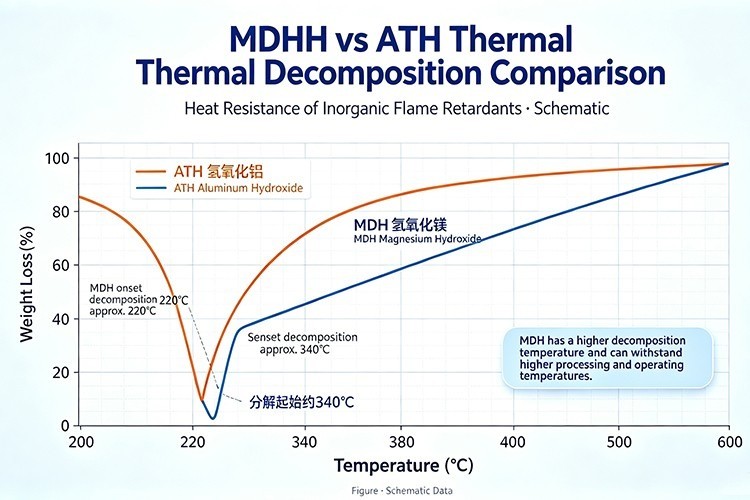
Magnesium hydroxide is an inorganic mineral compound. It contains no chlorine, bromine, fluorine or iodine, and it needs no antimony trioxide synergist. Its flame retardant action is purely physical: at around 340°C it decomposes endothermically, releasing roughly 31% of its mass as water vapour. The vapour cools the polymer and dilutes combustible gases; the magnesium oxide residue left behind supports char formation.
No halogen in the molecule means no corrosive HCl or HBr in a fire, and far less smoke than brominated systems deliver. That combination — halogen-free and low smoke — is why MDH is the default choice in LSZH cable and halogen-free rubber.
Practical tip: ask potential suppliers for the chloride value on the COA, not the sales datasheet. Low chloride is what protects electrical properties and moisture resistance in the finished compound.
What “halogen-free” is actually judged on
Test | Standard | What it verifies | Typical halogen-free requirement |
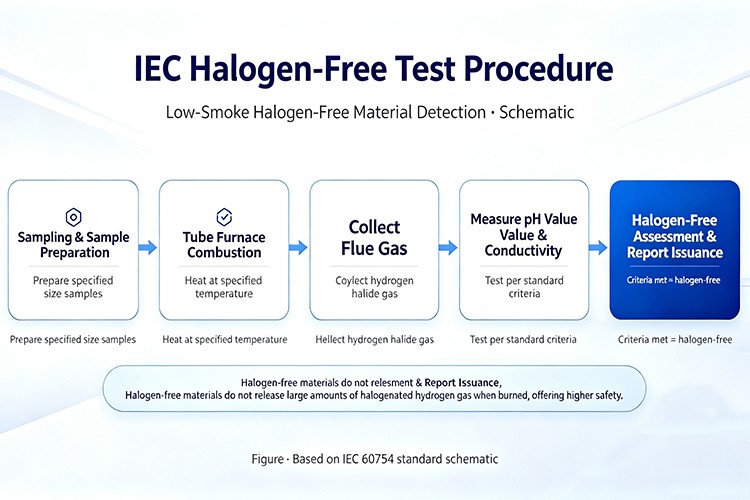
Halogen acid gas | IEC 60754-1 / EN 50267-2-1 | HCl + HBr emission during combustion | ≤ 0.5% (often reported as not detected) |
Acidity and conductivity | IEC 60754-2 | Corrosive gas formation | pH ≥ 4.3, conductivity ≤ 10 µS/mm |
Smoke density | IEC 61034-2 | Light transmittance through smoke | ≥ 60% |
Restricted substances | RoHS / REACH SVHC | No brominated FRs or restricted additives | Compliant statement required |
One nuance that catches people out: halogen-free is a property of the whole compound, not of the MDH alone. At 150 phr, a chlorinated paraffin plasticiser or a brominated additive will still fail IEC 60754 — and the MDH grade tends to take the blame. Silane coupling agents and stearate surface treatments, on the other hand, do not compromise the claim. Check the full formulation before you promise the test result to a customer.
MDH compared with ATH and brominated systems
Property | MDH (brucite-derived) | ATH | Brominated + Sb₂O₃ |
Decomposition temperature | ~340°C | ~200°C | 200–300°C (gas phase) |
Halogen free | Yes | Yes | No |
Smoke generation | Very low | Low | High |
Corrosive gas | None | None | HBr / HCl |
Typical loading | 140–180 phr | 180–250 phr | 20–40 phr + synergist |
Higher-temperature processing | Suitable | Limited | Not applicable |
Rule of thumb from the mixing line: once your processing or service temperature moves above about 180°C, ATH’s ~200°C decomposition window gets uncomfortable. MDH decomposes at ~340°C, which leaves real headroom — and it is equally halogen-free.
Where MDH fits in rubber applications
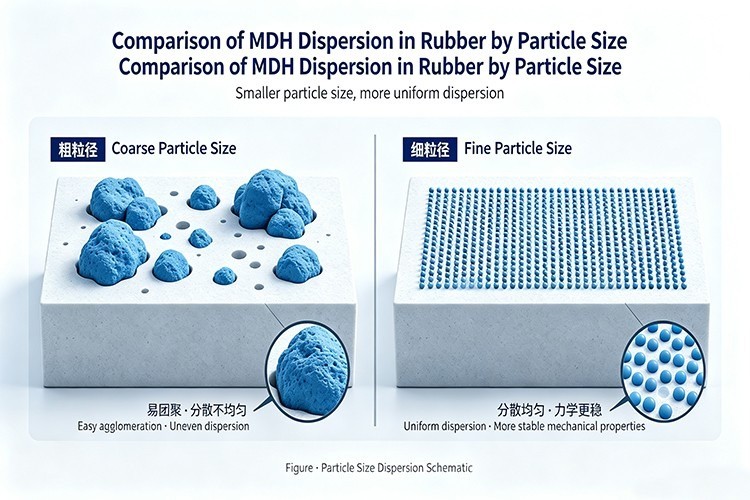
The usual applications: EPDM profiles, seals and gaskets for rail, automotive and construction; EVA sheathing and insulation for LSZH cable; silicone rubber parts for electrical and transport equipment; conveyor belts, mats and flooring. Loadings of 120–180 phr are common. At that level, a magnesium hydroxide flame retardant only performs when the grade is right: particle size distribution and surface treatment determine how much of the rubber’s original performance survives compounding. For high-loading work, ultra-fine magnesium hydroxide with D50 1.5–2.5 μm is the practical window where dispersion, flame efficiency and mechanical retention stay balanced.
Why brucite-derived MDH disperses well in heavily loaded rubber
Brucite is natural magnesium hydroxide ore. Grades produced from brucite typically show low iron oxide and chloride, which supports electrical properties and moisture resistance, and a plate-like morphology that disperses efficiently in rubber matrices. In practice, that difference shows up where compounders feel it most: extrusion surface quality and lot-to-lot repeatability at high loading.
Frequently asked questions
Is magnesium hydroxide flame retardant halogen free?
Yes. Magnesium hydroxide flame retardant (MDH, Mg(OH)₂) contains no halogen atoms and requires no halogenated synergist. The claim is verified at compound level using IEC 60754-1 and IEC 60754-2.
Can MDH replace brominated flame retardants in rubber?
In many EPDM, EVA and silicone rubber formulations, a magnesium hydroxide flame retardant can replace brominated systems. Loadings are much higher (140–180 phr), so fine particle grades and suitable coupling agents are needed to protect mechanical properties.
What particle size is recommended for rubber compounds?
Ultra-fine magnesium hydroxide flame retardant grades with D50 between 1.5 and 2.5 μm offer the best balance of dispersion, flame efficiency, surface finish and mechanical retention at high loading.
Why choose MDH rather than ATH?
A magnesium hydroxide flame retardant decomposes at about 340°C versus about 200°C for ATH, giving a wider processing window for compounds mixed or used at higher temperatures — and it is equally halogen-free.
Supplier reference points
If you are shortlisting suppliers for halogen-free rubber grades, the questions are the same whatever the vendor: lot-by-lot COA data (D50/D97, moisture, chloride); compound-level test reports to IEC 60754-1/2 and IEC 61034; RoHS and REACH statements; ISO 9001 certification; and pilot-scale support before committing a production line.
For reference, Victoryfr supplies ultra-fine brucite-derived magnesium hydroxide (D50 1.5–2.5 μm) from an integrated brucite source, 100,000 t/yr capacity — datasheets at www.victoryfr.com.
If you require formulation support or product datasheets for your rubber project, feel free to reach out for technical consultation.
